Email Domain Setup
Setting up an email domain has three parts: create the domain in the Console, add the DNS records, then create email addresses in the Agency app.
Step 1: Create the email domain
- Sign in to the eCourtDate Console and open the Domains section.
- Choose the customer from the customer switcher at the top left.
- Click Add Email Domain.
- Fill in the Create Email Domain form:
- Name: an internal label for the domain. This can be changed later.
- Domain: a subdomain of the agency's domain to send from (for example,
notifications.agency.govoremail.agency.gov). Use a subdomain, not the root domain. See Choosing the domain. - Agency: the agency this domain belongs to.
- Click Create. The domain is created with a Verification Pending status.
Step 2: Configure DNS records
After the domain is created, the Console shows the DNS records to add. Open the DNS provider and add them. See DNS Records for the full list and the exact format of each record.
At a minimum, add the verification TXT, SPF, DKIM, and DMARC records. Add MX records only to receive inbound email at this domain.
Copy each record from the Console, or use Download CSV or Notify to get them out as a file. If the DNS zone is managed by someone else, see Sharing the records with a DNS administrator.
Step 3: Complete the domain settings
Open the domain in the Console and review the additional settings on the edit screen:
- Monitoring Reports: a comma separated list of email addresses that receive daily and weekly domain health reports, including DKIM, DMARC, and SPF monitoring.
- Region: the region for the domain.
- Default Agency: the primary agency this domain is used in.
- Enabled Agencies: any additional agencies allowed to use this domain.
Step 4: Enable DKIM
DKIM adds a digital signature to the outbound email that proves it was not altered in transit. On the domain's DNS Records panel, if no DKIM records are present yet, click Enable DKIM. The DKIM CNAME records then appear in the records table to add to the DNS provider.
Step 5: Create email addresses under the domain
Verifying a domain makes it available to select. Nothing sends from it until an agency email is created on it, and an existing agency email keeps the domain it was created with, so an address created before the domain was verified stays on ecase.io until it is changed.
The agency email marked Primary is the one used by default, so put that one on the domain first.
- Sign in to the staging or production Agency app for the agency where the domain was enabled.
- Go to Admin > Settings and open the Agency Emails tab. The Email column shows the address each one sends from, and Primary marks the one used by default.
- Fill in the Create Agency Email form, choosing the domain in the Domain dropdown.
- Check the Email field. Choosing a domain fills the address in from the name, and it can be edited (for example,
listserv@email.agency.gov). - Click Create.
The Domain dropdown lists ecase.io plus every verified email domain. Set up correctly, the row marked Primary shows an address on the domain rather than @ecase.io:
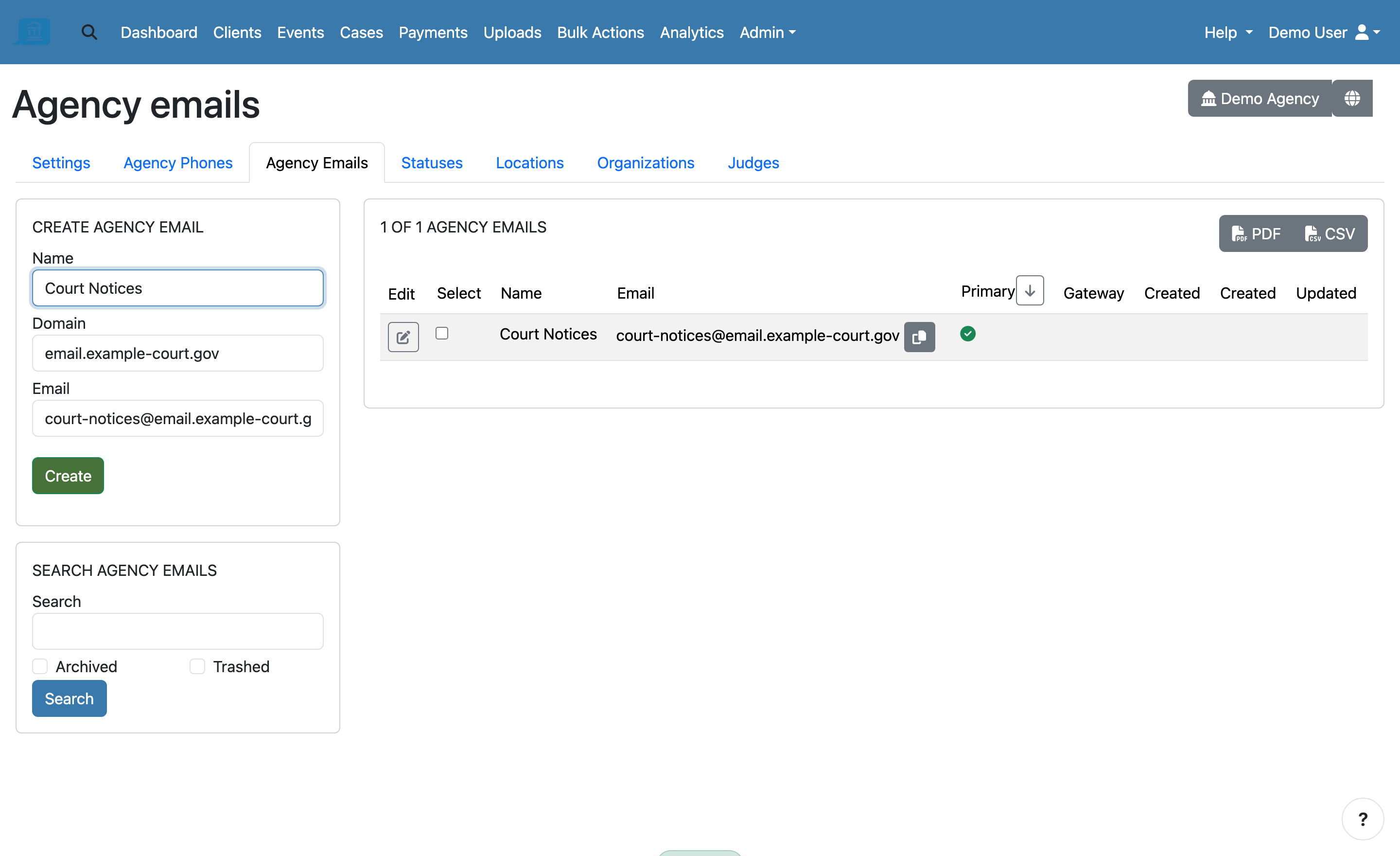
The Agency Setup Checklist counts Email Domains as complete only once the primary agency email sends from a verified domain, so a domain that verifies but is never used leaves that section outstanding.
There is no limit to the number of email addresses that can be created under a verified domain. Create separate addresses for different departments or purposes (for example, clerk@email.agency.gov, jury@email.agency.gov, support@email.agency.gov).
See also
- DNS Records: required records and exact values.
- Verification and Monitoring: verification status and the Monitoring Report.
- Troubleshooting: resolve deliverability and inbound issues.